15 Apr, 2026
10 Proven SaaS Customer Acquisition Tactics That Actually Work



If you’re struggling with SaaS customer acquisition, you’re not alone. Many SaaS founders and marketers are either burning budget on tactics that have stopped working, or they’re stuck in a cycle of inconsistent lead flow that makes scaling feel impossible.
In an episode of the SaaS Marketing Weekly podcast, I (Ryan James), founder and CEO of Rocket SaaS, shared a masterclass drawn from five years of growing my own agency to over $5M in revenue and from dozens of client campaigns. The result? Ten of the highest-impact SaaS customer acquisition tactics he’s seen work in the real world.
Here’s what I covered, and what you can start doing differently today.
Before getting into tactics, it’s worth addressing why so many SaaS businesses find customer acquisition so frustrating. The default playbook, cold email asking for demos, paid ads pointing straight to a free trial, is increasingly ineffective.
As I said on the podcast: “Most cold email campaigns for SaaS companies are cold emailing people that have never heard of you before, and you’re trying to get them to book a demo. It rarely works, and it works less than ever right now.”
The fix isn’t finding a better email tool. It’s rethinking what you’re asking people to do, and when.
Cold email still works. What doesn’t work is asking cold contacts to give you their time before they know who you are.
The shift is simple: stop leading with a demo request and start offering something genuinely valuable for free. My team offers a short Loom video auditing a prospect’s website, with no strings attached.
The cold email reads something like: “I’ve been on your website. I have some ideas on improvements that I’m confident will increase your conversions. Would you like me to make you a Loom video and send over my suggestions? This is totally free. I do it for five tech brands per month.”
As I said on the pod:
“We get around five responses per day of people saying yes please. You will get ghosted by quite a high percentage of people, but some will start to respond and you can land some really big deals this way.”
Other cold email offers worth considering include a free audit, a competitor comparison report, or a tailored growth plan. The key is that prospects don’t have to jump on a call to receive the value. A simple “yes please” is all that’s needed.
This tactic works best for mid to high-ticket SaaS products. If your MRR per customer is low, the economics don’t stack up.
This is one of the most underused SaaS marketing tactics, and is one of the best decisions I ever made.
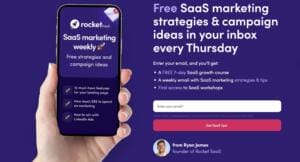
The idea is straightforward. Instead of publishing your podcast, newsletter, or educational content under your main brand, create a separate sub-brand with its own identity. Rocket SaaS runs “SaaS Marketing Weekly” as a standalone brand, complete with its own domain and landing page.
When you pump out your top-of-funnel content through your main brand, people are sceptical. People think, I’m not signing up to that newsletter because I’m going to be sold to. When you create a separate brand, you get much more trust from cold audiences.
The sub-brand feels less threatening. Subscribers come in looking for value, not a sales pitch, and engagement goes up accordingly. The trick is to include a subtle call to action back to your main brand within most content pieces, so that awareness converts over time.
If you’re going to do this, attach a personal brand to the sub-brand. People follow people, not logos.
Data-driven lead magnets consistently outperform generic ebooks and guides. If you’re a SaaS business, you’re sitting on a goldmine of aggregated customer data that your target audience would genuinely want to see.
A benchmarking report taps into something fundamental: the desire to know how you compare to others. I always give the example of a client in the self-storage SaaS space, Stora, who published average occupancy rates and pricing data from across their customer base. It drove significant engagement on LinkedIn because the audience couldn’t get that data anywhere else.
For a benchmarking report to work as part of your SaaS customer acquisition strategy, it needs to answer a question your ICP is already asking, such as: “How does my performance compare to similar businesses?” Create a dedicated landing page, run LinkedIn ads to it, and watch the qualified leads come in.
Most SaaS product teams build in silence and launch into a vacuum. A waitlist campaign flips this on its head.
The psychology is compelling. One of my favourite stats: a prospect only needs to be about 15% sure they’re interested to sign up to a waitlist, compared to around 75% certainty before they’ll book a demo. That difference in friction means significantly more leads entering your funnel earlier.
Build a landing page that makes the upcoming feature or product sound genuinely exciting, add a sweetener like early access or a launch discount, then promote it through LinkedIn ads, email, and organic content. By the time you go live, you already have a warm audience ready to convert.
This tactic works particularly well for lower-ticket SaaS products where volume matters more than deal size.
If there’s one theme that runs through every SaaS customer acquisition conversation I have, it’s consistency. Not one-off campaigns, but a relentless rhythm of content that keeps you visible to your audience week after week.
As I said in the masterclass:
“The businesses that really scale are the ones in that rhythm. They don’t miss a beat. They are always pumping out content. ‘I see you guys everywhere’, I’ve been following you for a while. That’s what people say on our sales calls.”
Most businesses create content when they have time, which means they don’t create enough. The solution is a structured content calendar built around a single central asset each month, with everything else flowing from it.
The most efficient way to maintain that content rhythm is to start with a podcast and repurpose outwards. This is the approach Rocket SaaS uses for both its own content and for clients.
The flow works like this. Record a 20-30 minute podcast episode every fortnight (recording two in one session). From that single recording, a video editor creates a full YouTube upload and five short-form clips for LinkedIn. The audio goes to Spotify and Apple Podcasts. The transcript is turned into LinkedIn posts, a blog, and an email newsletter.
All I had to do was show up and do the podcast, and all of this stuff happens on autopilot. We do not miss a beat. Every week there is a YouTube video, five short video clips, a podcast episode, five LinkedIn posts, a blog, and an email newsletter.
You don’t need a studio to start. The first 60 episodes of SaaS Marketing Weekly were recorded solo, in a room, with just a microphone. The point is to start and improve as you go.
In-person events are one of the most underleveraged SaaS customer acquisition channels. They don’t have to be expensive or elaborate.
My first breakfast event was a table of twelve at a chain restaurant in London. Total cost: $250. Outcome: $180,000 in pipeline and one signed client worth $60,000.
The format that works best is a roundtable or a short presentation that addresses a genuine problem your ICP faces. The content should be educational, not a sales pitch, with a clear but low-pressure call to action at the end. Right now, anything framed around how AI is disrupting an industry is generating strong attendance.
Start small. Book a restaurant table, invite your target audience, and pick up the breakfast bill. Scale up once you’ve found the format that works.
LinkedIn polls get significantly more engagement than standard posts because users have to vote before they can see the results. That creates a built-in incentive to interact.
The tactical application for SaaS customer acquisition is clever. Create a poll whose options map directly to your services. For example:
What’s your number one marketing goal for this year?
A) Redesigning your website
B) Growing your email list
C) Improving ad performance
D) Overhauling your strategy.
Then use your virtual assistant to work through every person who voted, qualify them, and send a personalised DM.
It’s a numbers game, but one that starts with a warm signal of intent.
The biggest conversion lever on the Rocket SaaS website wasn’t a new ad campaign. It was changing the primary call to action from “request a quote” to “apply for a free SaaS marketing strategy call.”
Consultative selling moves the call to action higher up the funnel. Rather than asking a prospect to evaluate your product (which requires near-purchase intent), you’re asking them to get free, tailored advice about their problem. More people are in the “figuring it out myself” stage than the “ready to buy” stage. Capturing them earlier means more calls, and more calls means more sales.
The key is to make the call genuinely about them. Audit their LinkedIn, discuss their value proposition, review their lead flow. The demo, if it happens at all, comes later.
Every single tactic above works better when you have a strong personal brand. It is the multiplier on everything else in your SaaS customer acquisition strategy.
There is no way the business would be anywhere near as big without the power of my personal brand. I’ve not even invested any money into it. It’s just been time.
The commitment is straightforward: post three to five times a week, engage with others in your space, and follow the 80/20 rule, 80% educational thought leadership, 20% content that makes clear what you do and who you do it for. It takes around three years to build meaningful reach, but the compounding effect on every other campaign you run is significant.
Not every tactic on this list will be right for your business at your current stage. But the structure is clear: build your personal brand and content rhythm as a long-term foundation, use targeted campaigns like cold email, polls, and events to generate pipeline in the short term, and shift your calls to action up the funnel wherever possible.
The businesses that struggle with SaaS customer acquisition aren’t doing too little. They’re often doing too much of the wrong things, or doing the right things inconsistently. The answer is focus, rhythm, and the patience to let it compound.
For more practical SaaS marketing tactics, subscribe to the SaaS Marketing Weekly podcast, available on Spotify and Apple Podcasts.


Receive actionable SaaS marketing ideas to implement in your business

By Ryan James