13 Nov, 2026
How to Increase Revenue Fast When You’re Behind on Target


Your investors are getting itchy, leadership isn’t happy with the numbers, and the pipeline doesn’t look like it’s going to carry you over the line this quarter.
Most advice on how to increase sales revenue points you at a new campaign. The honest answer on how to increase revenue in a hurry is that the money is usually already in your business: your CRM, your existing customers, your closed-lost deals and the keywords you’re already winning on.
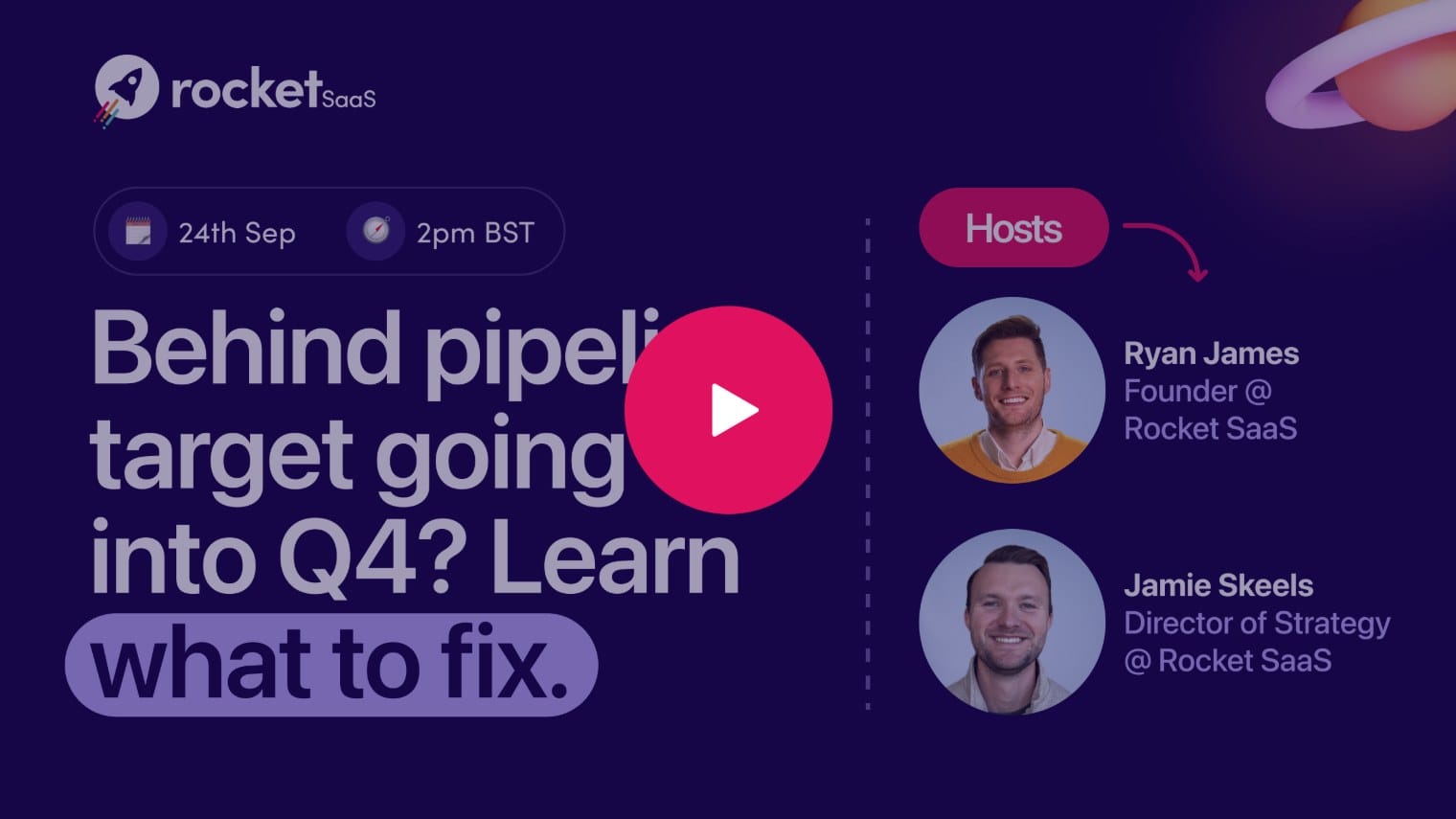
I ran a webinar on this covering six plays I rely on: analysing where your revenue comes from, mining existing customers, working closed-lost, building a referral system, fixing your bottom-of-funnel offer, and putting budget behind keywords that already convert.
The recording is on our webinars page, and the audio went out as episode 120 of SaaS Marketing Weekly.
These are the same plays we run for clients. Fonn went from 15 leads a month to 75 in our first year together, before their exit to The Access Group, and SurveySphere passed 60 leads a month in the first month after launching their product.
Before you build a single new campaign, go into your CRM and look at closed-won and closed-lost over the last 12 to 24 months. As long as the deals were a decent ICP fit, they hold most of the answers you need.
I got my own business to around £3 or £4 million in revenue without a clear picture of where leads came from or which segment closed fastest. We did the exercise below, doubled down on what it showed, and growth followed.
Every sales call should be recorded, and every deal should carry a paragraph or two on why you won it: what objections came up, what they said about pricing, why they booked the call. Exactly the same when you lose one.
I’ve been guilty of skipping that second part. You get the email saying they’ve decided not to go ahead, you feel grumpy, and you drag the deal into closed-lost without writing anything down. If you’re using AI to guide your marketing, that leaves it with nothing to work from.
If your notes are thin, go back through the recordings and fill them in. Good CRM hygiene won’t bring revenue this week, and nothing else here works without it.
Export every closed-won and closed-lost deal as a CSV. The columns that matter are the deal name, value, sales cycle length and the reason it closed or was lost.
Then export the notes and call transcripts. I use Fathom; Gong and Fireflies do the same job.
Put the deals and transcripts into Claude or ChatGPT and ask it to segment and summarise by shortest sales cycle, highest deal value and client type, with the most common reasons behind each. I won’t hand you a prompt, since you’ll get better results playing with your own.
What comes back looks something like this. These numbers are an illustration rather than our data, so run yours and see what you get.
| Segment | Close rate | Average sales cycle |
|---|---|---|
| SMB fintech, under 50 staff | 22% | 18 days |
| Mid-market | 14% | 45 days |
| Enterprise, 500+ staff | 6% | 120 days |
The first two are where your Q4 revenue lives. Enterprise is a Q1 problem.
Move budget into the fastest-closing segments. How much depends on how bad things are. If you won’t raise your next round without a strong Q4, move all of it. If you’re uncomfortable rather than desperate, around 80% is more sensible, since those slower deals still matter.
Then rewrite your messaging around the reasons deals closed, which is a different thing from your general value proposition. Some of what the AI surfaces won’t be usable: “the champion was already bought in” is true and you can’t build an ad on it. Others are a gift. “A competitor’s contract was expiring within 60 days” tells you to run switching offers aimed at that moment.
Do the same with the loss reasons. If pricing is the objection, look at your pricing. If people worry about onboarding and you already run a white-glove process, your ads and website never said so. It’s the same thinking as how we worked our B2B sales funnel backwards, applied to deals you’ve already had.
The fastest revenue available to you is in your existing customer base. My figures: when you’re upselling a client and a deal is on the table, you’ve got a 60% to 70% chance of closing it. A brand-new lead is 5% to 20%.
They’ve been through compliance, signed a contract, and built a relationship with you. There’s no sales cycle to run, and reaching out costs almost nothing.
The expansion plays worth working through:
Two more need handling with care. Shared logins are everywhere in software, and one login used by six people is revenue you aren’t charging for. Track it by IP address and start restricting it, without annoying people into leaving.
Over-usage is the same story, and British companies are too polite about customers running over their credits. Ask your product and dev teams what the data says.
Then spot the signals. Customers hitting usage limits should trigger a conversation from marketing and sales rather than sitting with the dev team. I’m a WP Engine customer, and every time we near our limit the emails, calls and LinkedIn DMs start. I hold out for a while, then we upgrade.
Renewals inside 90 days deserve an upgrade conversation alongside the renewal. Support tickets asking for higher-tier features are upsell signals that usually stop at the support team, and an AI agent flagging them would pay for itself quickly.
There’s more revenue sitting in closed-lost than almost anywhere else, and most businesses leave it there.
Start with deals you lost because your contact left. Follow them wherever they went, since a LinkedIn DM can restart the conversation at their new company. Then use LinkedIn Sales Navigator to find whoever replaced them. Somebody new in a role is usually looking to change systems and make their mark, and “we were midway through a conversation about this; would you like to pick it up?” is an easy message to send.
This has worked well for a lot of our clients. Say you lost a deal to a competitor on a 12-month contract. Most businesses wait 10 or 11 months and then get in touch about renewal.
Go much earlier. Reach out when they’ve got 7 months left and offer to cover them: switch today, pay nothing until the old contract would have ended, and sign with you for at least a year afterwards. They get the platform they wanted without paying twice.
It’s a real financial hit depending on your cost to serve, and it brings signed contracts into Q4 even when the cash lands later, which is often what investors look at. Sales can lead with a PDF.
Most closed-lost outreach is one cold email fired at everybody asking whether they’d like to work with you now. You can do far better.
Feed your closed-lost deals and transcripts into Claude and ask for a personalised message for each one. The results are good enough that people reply saying they can tell it isn’t a bot. Edit out the cheesy openers first.
Use the loss reasons to brief your ads too, grouped by theme, so the 20 companies that didn’t buy because you lacked a particular feature all see ads about the feature you now have.
Three more worth running:
Everybody knows they should be doing referrals, and almost nobody has a system, so it comes down to hoping happy customers mention you to someone. A B2B referral program that works is mostly a routine:
Build it into your systems so it can’t get forgotten. We use Asana, and six months into every client, a task is created automatically telling us to start the referral conversation. That’s why ours go out consistently.
If demo bookings have underperformed for three quarters, more ad spend just buys more of the same. Change the offer.
A time-limited discount across ads, email, and cold outreach is the obvious move, and plenty of you aren’t doing it.
The one I’d push harder is a second call to action higher up the funnel. Our main CTA used to be “request a quotation”, which only ever gets filled in by people at the very end of their buying journey. Keep it, and add a free strategy call, audit, or action plan limited to five businesses a month.
Qualify everyone who applies, because a lower close rate on those calls is the trade. Filling in the form isn’t a guaranteed booking, and you decide who you accept. Done properly, it accelerates everything, and it was transformational for my business. You can book a free SaaS marketing strategy call to see how we run it.
Competitor comparison campaigns are the other play, because anyone looking at a competitor is near the end of their buying journey and they did the awareness work for you. Bid on their keywords in Google Ads, run LinkedIn campaigns in the style of ActiveCampaign against Mailchimp, and build comparison pages with a feature table. If closed-lost tells you which competitor won a deal, point the campaign at them.
Your biggest competitor is the status quo. More deals are lost to “we’ll keep doing it in-house and save the money” than to any rival.
A 30-day money-back guarantee handles that objection, or 90 days if you’re confident. An outcome-based pilot does it better still: hit these metrics, or you get your money back. In my experience, as long as you work hard and behave like a decent partner, only around 10% of people ask for the money back when a target is missed.
Shortening the contract is the other lever. A 12-month commitment reads as a £100,000 decision to a CFO. Break clauses at 3, 6 and 9 months make it feel like a £10,000 decision, and that changes the answer.
Put it on a landing page, into a PDF, and into ads, then let sales take it to everyone in closed-lost and everyone mid-conversation.
When we audit a client’s Google Ads account, we nearly always find the same two problems: money going to keywords that never convert, and not enough on the ones that do.
Impression share is the percentage of eligible searches your ad appears for. Find the keywords driving your conversions, then look at that number.
Say “best CRM for charities” drives most of your conversions and your impression share on it is 24%. That means 76% of the people searching the term you win on never see you, and the fix is budget.
Trim the keywords wasting spend and push that money into the ones that convert, getting your impression share as high as you can. If you’ve switched Google Ads off because it didn’t work, this is usually why: too many keywords, too many clicks from people who were never going to buy. Our Google Ads work starts here.
Then add high-intent retargeting. Using the LinkedIn Insight Tag, build audiences from people who visited your pricing or demo page and didn’t convert, and match the offer to the page. Pricing page visitors see a discount, since price is usually what stopped them. Demo page visitors see the strategy call, since they weren’t sure your product was right for them.
The six plays, in order:
One caveat before you move everything. The fast-closing segments fix this quarter, and your longer enterprise deals are what next year is built on, so move budget in proportion to how urgent the gap is rather than emptying the slower campaigns because December is coming.
If you want a second pair of eyes on where your fast revenue is hiding, that’s what we do on a strategy call.
Export your closed-won and closed-lost deals as a CSV with the deal name, value, sales cycle length and the reason each one closed. Add your call transcripts, then ask an LLM to segment and summarise by shortest sales cycle, highest value and client type.
What you’re looking for is where you win fastest, and the reasons behind it. Those reasons become your targeting and your messaging.
Impression share is the percentage of eligible searches your ad appears for. An impression share of 24% on a keyword means 76% of the people searching that term never see you.
It’s the quickest way to find out whether your best keywords are being held back by budget rather than performance.
There’s no universal number worth chasing. What matters is impression share on the keywords driving your conversions, and getting that as high as your budget allows.
Low impression share on a keyword that converts is money left on the table. High impression share on a keyword that never converts is money being wasted.
Start with what you already have rather than a new campaign. Analyse your closed-won deals to find your fastest-closing segment, upsell your existing customers, work your closed-lost list, and ask for referrals systematically.
All four produce revenue faster than generating new leads from cold, and all four cost less.
Watch for signals instead of asking at random. Customers hitting usage limits, renewals inside 90 days and support tickets requesting higher-tier features are all openings.
Remind customers what’s on the plan above theirs, because plenty of them signed up years ago and have never looked since.
CRM hygiene means every deal carries the notes and call recordings that explain what happened to it. A paragraph on why you won, what objections came up and what they said about pricing, and the same detail on every deal you lost.
It’s dull, and it’s what makes AI analysis of your pipeline worth anything at all.


Receive actionable SaaS marketing ideas to implement in your business

By Ryan James


