16 Jan, 2026
B2B Growth Strategy: 10 Proven Ways to Scale SaaS Revenue



Growth in B2B SaaS looks simple on a chart. In reality, it’s usually a mix of small wins across acquisition, onboarding, retention, and pricing.
In 2026, that matters more than ever. It’s harder to buy attention, buyers take longer to decide, and AI features can push costs up if pricing stays the same. So the aim is not to “do more marketing”. It’s to build a growth system that holds up.
This article breaks down ten practical strategies that actually affect ARR.
In SaaS, growth isn’t just about new customers. It’s about keeping revenue you already have, expanding it, and making sure acquisition pays back fast enough.
McKinsey research shows that top-quartile B2B SaaS companies achieve net revenue retention of 113%, meaning they grow more than 10% annually even without acquiring new customers.
SaaS Capital data shows that companies with net revenue retention above 100% typically achieve significantly faster overall growth rates.
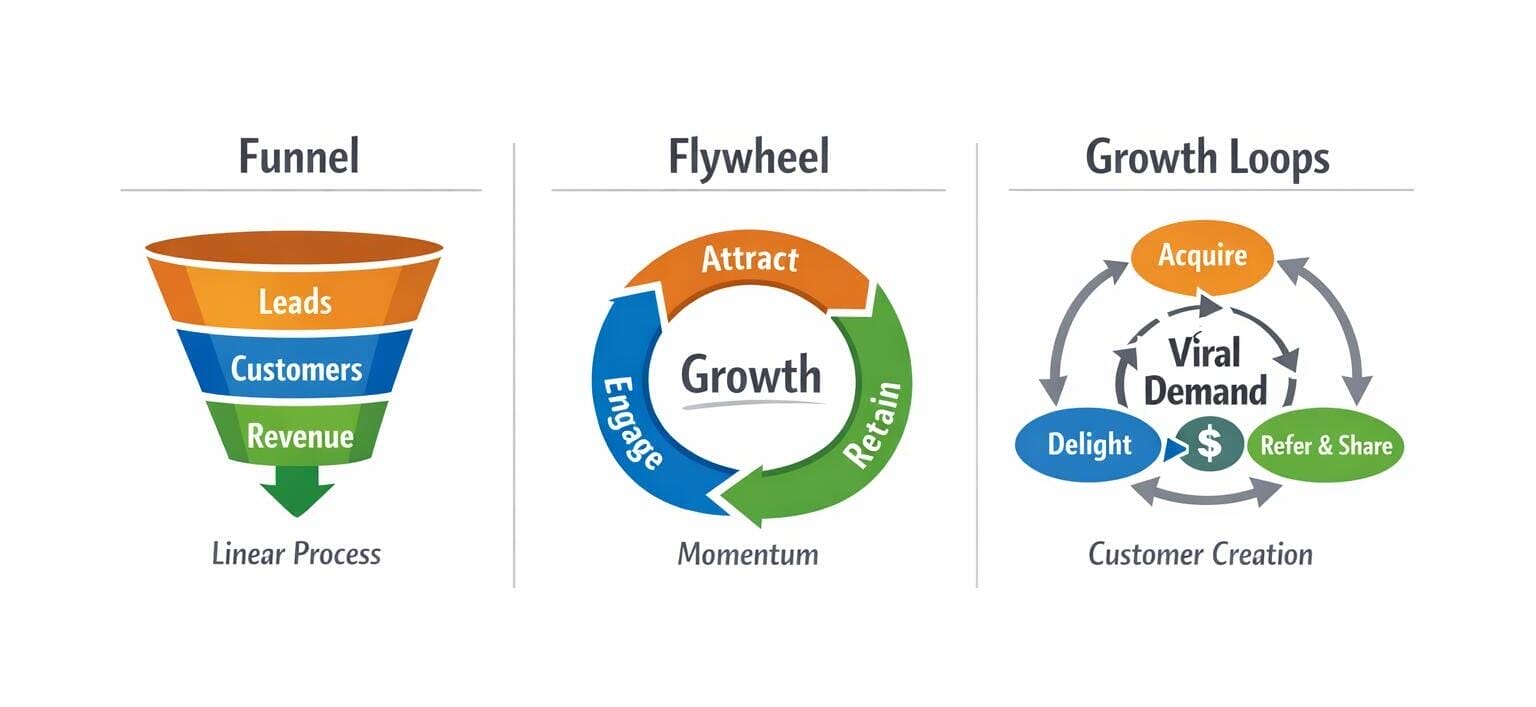
This shift in focus is why many SaaS companies move from a simple funnel model to a flywheel or growth loop, where satisfied customers drive expansion, referrals, and long-term revenue.
A simple way to think about it is:
New ARR + Expansion ARR − Churned ARR
That’s why marketing, product, sales, and customer success can’t work in isolation. The customer journey is one journey, even if different teams own different parts of it.
How you generate pipeline from the right accounts.
Acquisition is about attracting and converting the accounts that actually fit your product, not just driving traffic for the sake of it. Strong acquisition focuses on ideal customer profile alignment, clear positioning, and messaging that speaks directly to real pain points.
You are not trying to reach everyone. You are trying to reach the right buyers, in the right industries, with the right level of urgency. That means refining your targeting, improving your demand generation channels, and tightening your sales and marketing alignment.
Effective acquisition balances inbound and outbound strategies. It relies on compelling content, sharp paid campaigns, smart account-based marketing, and consistent follow-up. When done well, your pipeline becomes predictable rather than reactive. You stop chasing leads and start building a steady flow of qualified opportunities that are far more likely to convert.
How quickly new customers reach their first success milestone.
Activation is the bridge between signing a contract and delivering real value. It measures how quickly your new customers experience their first meaningful win. The faster they see success, the more confident they feel in their decision to choose you.
Many SaaS companies lose momentum here. Complex onboarding, unclear next steps, and poor communication slow everything down. Your goal should be to remove friction at every stage. Simplify setup, guide users with clear workflows, and show them exactly what “success” looks like.
Activation is not just a product issue, it is a cross-functional priority. Sales, customer success, and product teams all play a role. When onboarding is intentional and structured, customers reach value faster. That early momentum builds trust, increases engagement, and sets the foundation for long-term retention.
How you reduce churn and increase customer lifetime value.
Retention is where sustainable growth is won or lost. It is far more cost-effective to keep an existing customer than to acquire a new one. Yet many companies invest heavily in acquisition and neglect the experience after the sale.
Reducing churn starts with understanding why customers leave. Is it lack of product adoption, poor support, misaligned expectations, or competitive pressure? Once you identify the drivers, you can design proactive strategies to address them.
Strong retention strategies include regular value reviews, usage monitoring, ongoing education, and responsive support. You should be anticipating problems before they become cancellation requests. When customers consistently see measurable results from your product, they stay longer. As lifetime value increases, your growth engine becomes more efficient and resilient.
How you grow revenue through upgrades, add-ons, and seat growth.
Expansion is where SaaS revenue truly compounds. Once a customer is successful and engaged, the opportunity to grow the account becomes far easier than landing a brand-new logo.
Expansion can take many forms, upgrades to higher tiers, additional features, add-on modules, or increased user seats. The key is alignment. You should only promote expansion when it directly supports your customer’s goals.
This requires deep account insight. Understand how your customers use your product, where they see results, and where their needs are evolving. Proactive account management, usage data, and clear packaging all contribute to expansion success.
When acquisition brings in the right accounts, activation delivers quick wins, and retention keeps customers satisfied, expansion becomes a natural next step. Together, these four pillars create a growth model that is stable, scalable, and built to last.
Most SaaS companies try to grow everywhere at once. That’s when budgets get spread thin and results get messy.
Pick the one that matters most for the next 6 to 12 months. Then align your plan, spend, and targets around it.
If growth only comes from ads or outbound, it’s easy to stall when costs rise.
Strong SaaS products bring in demand through usage. That can look like:
The point is simple. The product should help with reach, not just delivery.
Funnels focus on moving people from visit to conversion. Loops focus on what happens after someone becomes a user. And that’s often where growth comes from.
A growth loop is when one action creates another user, lead, or opportunity. For example:
The win is compounding. One user can lead to the next.
More traffic doesn’t fix a product that people don’t stick with. It just gives you more drop-off to deal with.
Start by defining your first value moment. That’s the point where a user gets a real outcome and thinks, “okay, this works.”
Then remove the friction that stops them getting there. This is usually:
When activation improves, your acquisition spend becomes more efficient.
Churn is not just a customer success problem. It’s a growth limiter. Every lost customer increases the pressure on acquisition.
Start with the basics:
The goal is not “zero churn”. It’s better net revenue retention.
Pricing is one of the fastest levers you have. Most teams just avoid it because it’s uncomfortable.
In 2026, it matters even more, especially when AI features create variable costs. If pricing stays flat while usage climbs, margins take the hit.
Test pricing and packaging more often. That might include:
Keep it simple. Charge in a way that matches how customers get value.
A lot of SaaS demand exists outside your home market. But payments, taxes, and localisation often stop people from buying.
If you want international revenue, fix the blockers:
This is one of those areas where removing friction can lift conversion without changing the product.
When messaging is aimed at everyone, it feels relevant to no one. That hurts conversion, sales cycles, and retention.
Define your serviceable addressable market clearly. Then build around it:
You can always expand later. But focus usually wins first.
Growth slows when teams chase different goals. Marketing optimises for leads, sales optimises for close rate, product ships features, and customer success fights churn.
Alignment looks like:
When this works, CAC drops and retention improves. Not because of one tactic, but because the experience makes sense.
Lagging metrics tell you what already happened. They don’t help you steer.
Best-in-class SaaS companies often achieve net revenue retention above 130%, driven by strong expansion revenue.
Track metrics that change how you act:
If these move in the right direction, ARR tends to follow.
A good example of these principles in practice is our work with Fonn, a construction tech SaaS operating in a competitive, crowded market.
Rather than trying to “do everything,” we helped Fonn decide how they would grow first, then built the system around that decision.
The focus
Fonn’s priority was simple:
This meant prioritising one growth motion for the next six months:
Narrow ICP, strong positioning, and demand generation that sales could actually convert.
What we changed
Instead of relying on a linear funnel, we designed a loop-based system:
Each asset fed the next. Nothing existed in isolation.
The result
Within six months:
The key wasn’t more channels or more spend.It was choosing how to grow, then aligning product messaging, demand generation, and conversion paths around that decision.
Rocket SaaS is a B2B SaaS marketing agency. We help software companies increase ARR through clear go-to-market planning, demand generation, lifecycle improvements, and revenue-focused SEO. Book a call today to talk through your goals and see whether Rocket SaaS is a good fit.


Receive actionable SaaS marketing ideas to implement in your business

By Ryan James